 PORT MOBILITY CIVITAVECCHIA


National Archeological Museum of Civitavecchia
National Archeological Museum of Civitavecchia: a jump back into the past among Etruscan finds, bronzes, pottery and much more.


The National Archeological Museum of Civitavecchia, also known as City Museum, is located inside the eighteenth-century building commissioned by Pope Clement XIII in the eighteenth century, a stone's throw away from Fort Michelangelo.
The museum preserves the main historical and archaeological testimonies of the city, including also artefacts from the territory, both from the coastal sites and from the mountains of Tolfa. We remind that the city of Civitavecchia was founded by the emperor Trajan to be the port of Rome, a role it still has today.
If you are in the surroundings and have a couple of hours to spend in the city, we recommend to visit it...
VISIT ITINERARY
The Archeological Museum of Civitavecchia presents an itinerary designed over two floors, with records from the dawns of civilization, during the whole Ancient times, until the Middle Ages.
Extension works are planned. We will keep you updated!
GROUND FLOOR
The exhibition route opens on the ground floor with two symbolic masterpieces of the museum: a statue of the god Apollo (1st century AD), discovered during excavations at Villa Simonetti in Santa Marinella, the ancient summer residence of the Roman jurist Aeneas Domitius Ulpianus. It is highly likely a reproduction of the Colossus of Rhodes. Also of particular importance is a reproduction of Phidias’ Athena Parthenos dating back to the mid-2nd century AD, alongside several marble heads, including one depicting the emperor Marcus Aurelius as a young man.
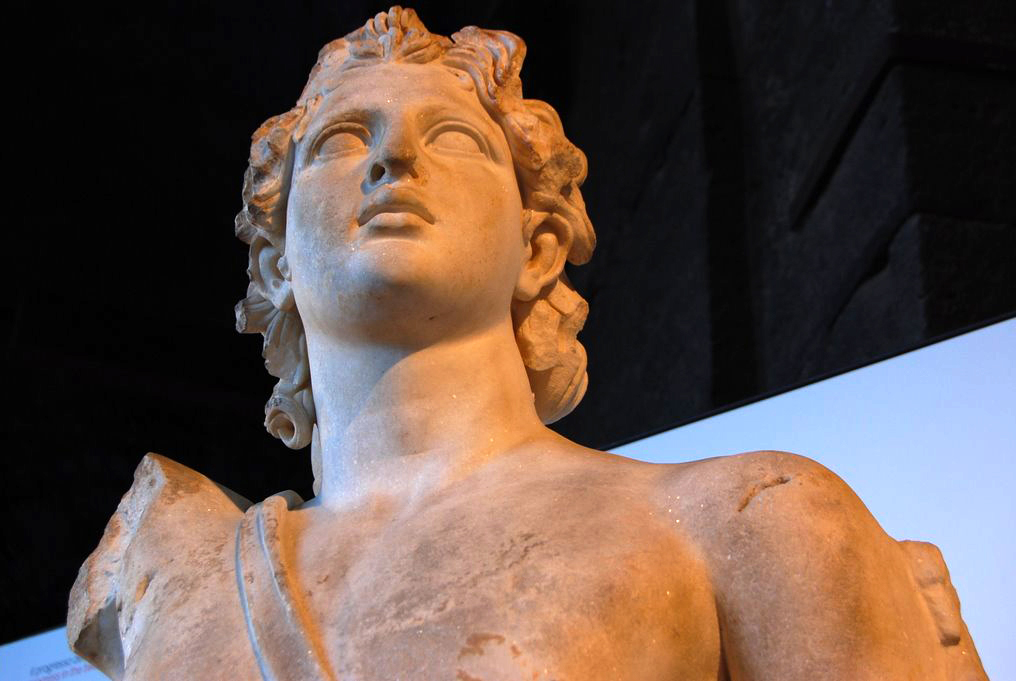
Archeological Museum of Civitavecchia - Statue of Apollo

Fidia's Athena Parthenos
Inside the space, video projections, lighting design, and soundscapes enhance the monumentality of the works, introducing visitors to the story of the local area through an emotional, multi-sensory experience.
Recently at the ground floor has also been opened a new Epigraphic Room, hosting, besides the wonderful Roman epigraphs of the Imperial Fleet, also two new invaluable finds: a head of nymph from Hadrian times, discovered close to the Taurine Baths and a figurehead with female bust made with solid bronze of Roman times, discovered in mid 800 in the port, donated by then prince of Ardia to the National Museum.

Archaeological Museum of Civitavecchia - Ground Floor - Photo by Luciano Giobbi
FIRST FLOOR
The first floor is dedicated to the history of the local territory from prehistory to the Etruscan and Roman eras, with a focus on the main archaeological sites along the coastal strip between the Mignone River and Cerveteri, as well as the Tolfa Mountains. Here, visitors can admire a selection of ceramics and bronzes, alongside fine examples of buchero pottery from the region’s principal settlements: Castellina del Marangone with its Etruscan necropolises (Marangone and Volpelle), and Aquae Tauri with the Etruscan necropolis of Pisciarelli.
In particular a gobblet decorated by impression (seventh century BC), an splendid balsamario with a female figure on her knees in front of another woman (of Egiptian inspiration and origin, sixth century BC), and some black-coloured ceramic vases (fourth century BC). Not to be missed is also some metal finds with a bronze ring and a gold earring of valuable refinement.
Bucchero is a class of black ceramics, usually thin and light, made by Etruscans to realize decorated vases with various tecniques: from incision, to mould design, to use of ornamental elements.

Archeological Museum of Civitavecchia- photo Luciano Giobbi
A dedicated section explores the Etruscan sanctuary of Punta della Vipera, detailing its evolution from the Archaic period to its Hellenistic transformations. The exhibit also features a full-scale reconstruction of the temple's decorative elements, a tactile model, and a 3D model that visitors can explore using virtual reality headsets.
The other showcase display a series of precious objects from the Museum's collections, chronologically exhibited through the entire cycle of Etruscan culture. The exposition closes with materials from the Taurine Baths and the proto-Villan necropolis of La Pozza (Allumiere).

Liturgical furnishings at the National Archaeological Museum of Civitavecchia - Photo by Luciano Giobbi
SECOND FLOOR
The second floor, inaugurated in 2026, tells the story of the birth and development of Centumcellae, the monumental port commissioned by Emperor Trajan and designed by Apollodorus of Damascus, alongside the Taurine Baths (Terme Taurine) and the network of maritime villas that defined the coastline.
The exhibition continues with a section dedicated to the medieval town of Leopoli-Cencelle, illustrating the transition from the Roman era to the Middle Ages through artifacts, scale models, reconstructions, and digital tools. A large tactile model of the city, immersive videos, and archaeological finds from excavations offer insights into the founding of this new settlement commissioned by Pope Leo IV, its urban layout, and the daily life of the medieval community

Tactile Model of the City of Cencelle - Photo by Luciano Giobbi
THIRD FLOOR
The third floor, also newly designed, is dedicated to the historical collections of the former Civic Museum (Museo Civico), originally established in 1918 in the cloister of the Santa Maria Church convent, which was destroyed during the 1943 bombings.
The new exhibition setup brings numerous artifacts previously kept in storage back into public view, while also featuring a significant selection of items recovered from archaeological seizures.
Among the most prominent works is the extraordinary Etruscan cinerary urn of Caeretan origin—a unique masterpiece belonging to the same artistic tradition as the famous Sarcophagus of the Spouses (Sarcofago degli Sposi)—brought to life through a 3D digital model and immersive video projections. Completing the floor are a laboratory for primary conservation interventions and a multifunctional hall for educational activities, lectures, and conferences. A flexible space designed to support collection rotation and offer new opportunities for learning and community engagement.
Enjoy your visit!
Useful information
- HOW TO GET THERE
The Museum is situated close to the entry point of Varco Fortezza (Fort Michelangelo) of the Port of Civitavecchia.
- TIMETABLES
- 8:30 am – 7:30 pmThursday, September 24, 2026: special closure from 1:30 pm to 7:30 pm Starting May 29, 2026, the museum tour includes only the third floor, featuring the exhibition "The Body That Remains: Prothesis in the Etruscan Urn of Civitavecchia and Contemporary Resonances." The other areas of the museum are closed due to extraordinary renovation and cognitive accessibility works.Closing days:Monday, January 1, December 25
- PRICES
The entrance fees are:
Full ticket: 3 eurosReduced ticket: 2 eurosFree admission according to the provisions of the Ministry of Culture